
ABSTRACT
Kente has always represented the boldness and inventiveness of Ghanaian identity, culture, pride, and artistic ability. Recent decades, however, have seen a radical modern reimagining of the pattern. Through TikTok, it has promoted an attitude that is characterized as nasty and bougie, blending in with Instagram, high couture runways, and urban street wear scenes. A fresh canvas of self-expression that we sailed on far beyond the world’s oceans, the cloth changed from its traditional ceremonial garment roots in Ghana when the current of international attention passed over Kente. Deepening the danger with all this praise and attention comes a dangerous double-edged sword. The problem is that although some designers celebrate and elevate their roots while engaging their communities, many just co-opt what grew there into an aesthetic movement, stripping away the communities that produce it. This paper examines the ways in which Kente is being redefined within contemporary fashion, how it is being perceived on the global market, and the impact that it has on local weavers who still labour intensively to produce Kente by hand. The report takes its cues from recent scholarship, cultural commentary, and economic observance to meditate on how craft can exist and excel in a world that moves ever more quickly.
INTRODUCTION
Kente is no longer limited to ancestral ceremonies, royal celebrations, or Ghanaian festivals. It is a worldwide craze, whether it takes the shape of red carpet gowns, digital prints, headwraps, sneakers, or bags. It has been worn by A-list celebrities from throughout the world, including Madonna, Michelle Obama, and Oprah. Designers of fashion have their own opinions. It is still used by diaspora populations as a symbol of cultural bonds and ethnic pride. Its visibility is indeed increasing, so is the chasm separating visibility from value, for the millions who still craft it the old-fashioned way.
This paper will discuss the contemporary history of Kente cloth, its stylistic significance, and cultural use. It starts with the process as the fabric is being transformed by new waves of Ghanaian designers, then focuses on how the fabric is viewed around the world, and finally addresses the plight of the local artisans who are unfortunately most often cut out of the profits and recognition. Although we can’t argue that Kente is not on the rise, in visibility, the future of Kente’s prosperity is in how the world decides to interact with it as more than a trendy design, but as a living cultural narrative that deserves to be preserved.
LITERATURE REVIEW
Kente’s history and symbolism have been extensively documented, but more recent studies are starting to concentrate on its contemporary adaptations and position in the multinational fashion industry. How Ghanaian and foreign designers are redesigning Kente for new audiences, fusing tradition and innovation, has been studied by academics like Riccio (2020) and Gristina (2020). According to this research, Kente has evolved from its ceremonial use among the elite to its current usage in high fashion, casual settings, and digital technologies.
Scholars such as Alyssa Octavia Johnson and Kidada E. Williams build on this tension between acknowledgment and appropriation. NTU (2024) discusses how the recent increase in demand for Kente has led to mass market reproductions that are often printed on synthetic fabrics and sold at a profit without crediting or compensating the original makers. To better protect cultural ownership, this has prompted a broader conversation around intellectual property rights and Geographical Indication (GI) protection.
Towns that produce cloth, Bonwire and Agbozume among them, are simultaneously pleased with Kente’s global success and troubled that they are losing out, according to field research on these artisan towns. While some craftsmen have adapted by working with designers to make new goods, many others are still engaged in traditional practices for local markets, making them unable to compete with faster, cheaper reproductions of their craft.
One theme that comes up over and over in the literature is this: Kente is changing, no doubt about it, whether this evolution truly honours the people and culture that produced Kente, the tradition, or not remains to be seen.
OBJECTIVES
- To identify how modern designers are reinterpreting Kente in fashion and design.
- To assess the global recognition and use of Kente in international media and events.
- To examine the economic and cultural impact of mass production and imitation.
- To understand the current challenges faced by traditional Kente weavers in Ghana.
- To reflect on ways to protect Kente’s authenticity while supporting its evolution.
METHODOLOGY
Drawing from online interviews, fashion reports, cultural essays, and journal articles published between 2019 and 2025, this study employs a qualitative methodology based on secondary research. Kente’s adaptation by contemporary designers, its reception in international settings, and the experiences of local weavers as this fabric gains popularity and commercialization are the main topics of the study.
I looked at media coverage of cultural appropriation, economic statistics about artisan livelihoods in towns like Bonwire and Agbozume, and fashion case studies featuring both Ghanaian and foreign collaborations. In order to comprehend the extent of Kente’s visual reach, social media content such as Instagram posts and appearances during fashion week was also taken into account.
Understanding how Kente is being utilized, who benefits from it, and what might be lost when tradition turns into a trend were all part of the methodology’s objectives. This multi-layered study aids in reflecting not just the current state of Kente but also its implications for the communities that have sustained it throughout the years.
RESULTS
In an accompanying, detailed report written by Cole, That Kente Cloth, the authors contend that Kente has entered the global fashion lexicon and can be seen on everything from DIY designs to high-end couture. Young Ghanaian designers are at the forefront of the movement to reintroduce woven cloth, mixing modern silhouettes, streetwear sensibilities, and a young designer’s individuality with heritage techniques.
Due to their creative reworkings, Kente became more visible on international fashion runways and more familiar to the younger generations. The textile has faced challenges despite its explosive surge in popularity. International celebrities and corporations have used prints with a Kente pattern, although frequently without giving credit to the original creator. Frequently, the resulting textiles are replicated digitally. The beauty of Kente is replicated in these machine-printed textiles, but its profound cultural and symbolic meaning is lost. These goods present a bigger temptation to customers worldwide since they are easier and less expensive to make. Traditional craftspeople’s livelihoods are strained by them.
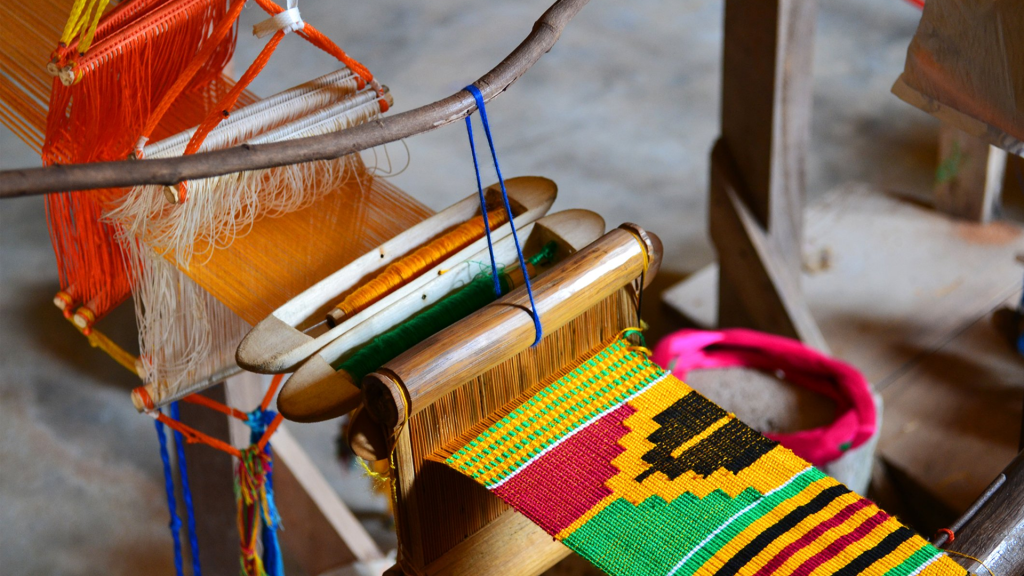
The effects on local weavers are not entirely positive. Through export channels and collaborations, some have discovered new prospects. Others, however, deal with dwindling sales and a diminished respect for the handcrafted method. Although Kente is worn all over the world, many craftspeople are concerned that fewer people are aware of or interested in its history. Although skilled weavers teach their technique in places like Bonwire, the craft’s lengthy learning curve and diminishing profitability discourage future generations from pursuing it.
It becomes evident that although Kente is benefiting from publicity, its inherent worth could be compromised. Going forward, the issue is to ensure that acknowledgment is accompanied by fairness, respect, and sustainable procedures that safeguard the fabric and the hands that weave it.
DISCUSSION
Kente’s development is a prime illustration of how, with careful handling, tradition may change without losing its roots. Streetwear collections and international fashion runways are examples of contemporary interpretations that demonstrate Kente’s continued relevance. It has significance. However, the question of who gets to tell the story arises when it becomes more popular and lucrative.
Designers frequently make a conscious effort to respect Kente’s place of origin, particularly those from the Ghanaian diaspora. They employ traditional methods, work with weavers, and instruct consumers. However, others frequently reduce Kente to a “print” something ornamental, divorced from its traditional significance, particularly in international markets. When used in this way, a potent cultural emblem runs the risk of becoming just another trend.
The individuals who produce Kente as their ancestors have done for centuries, the local weavers are the heart of the issue. Even as the cloth garners more attention, many of these craftspeople struggle to make ends meet due to competition from less costly, machine-made options. For them, Kente is far from just wearing beautiful cloth. It’s an identity, a history, a wealth. Now, in its worldwide rise, the same people who have maintained Kente’s vitality face being pushed to the periphery unless deliberate efforts are made to support these communities.
Ironically, in this exceptional case, balance is even more important. Kente needs to be liberated to grow, elevate, and prosper around the planet, never at the expense of the masters who craft that magnificence. Legal protections such as Geographical Indication (GI) status, proper attribution, and a just, equitable, and sustainable fashion industry will prevent that scale from tipping. In order to prevent that admiration from crossing the line into appropriation, it’s important that you help others understand Kente’s cultural and historical significance.
CONCLUSION
More people than ever may be aware of Kente, but knowing about a culture’s customs doesn’t mean you respect it. Despite the environment that surrounds its works waxing seen on international runways and Instagram pages, underneath the bold colours and symbolic iconography lies a more intricate narrative deeply rooted in Ghanaian culture, craftsmanship, and heritage.
As this essay has demonstrated, the new popular embrace of Kente as an aesthetic tool by the global African diaspora has spurred in its wake new avenues of innovation and self-expression. At the same time, it has exposed some serious inequities in who gets to benefit from that rising popularity. Since the fabric is a living tradition, the voices of the master weavers must remain at the centre of the Kente narrative.
There’s so much to Kente as an object to learn from, to preserve, to honour and respect, rather than just something to wear or drape.
FURTHER STUDY
Future writing should aim to involve these Ghanian weavers, fashion designers, and textile merchants to help continue articulating this crucial conversation. Younger Kente(identity), seeing individuals from rural and urban backgrounds alike, are creating negative or positive impressions of Kente is the first step in knowing and arguing its future path. Kente’s role within the broader African fashion ecosystem would be better served by comparative studies to other African heritage textiles, like Mali’s Bogolanfini or Nigeria’s Aso Oke. Further research from academics and legislators alike would surely be a welcome supplement to the existing literature advocating how GI protections or ethical branding can be and indeed should be utilized to better protect cultural heritage.
REFERENCES

Afriklens. (2024). The meaning behind the famous Kente cloth of Ghana.
Gristina, S., & Arleo, M. (2020). The Korai x Kente project: Turning the handmade Ghanaian Kente cloth into a contemporary creative fashion tool. Academia.edu.
Kraamer, M. (2023). The making, use, and evaluation of Ghanaian textiles. Afriques Amériques. OpenEdition.
Moments Log. (2024). The vibrant world of Ghana’s Kente cloth: Weaving history and identity.
NTU Research Blog. (2024). Ghanaian Kente textiles: Fashion and Geographical Indication protection. Nottingham Trent University.
Riccio, B. (2020). A cloth to wear: Value embodied in Ghanaian textiles. In Fashion, Dress and Society (pp. 85–97). Springer.
Wikipedia contributors. (2025, June). Kente cloth.